
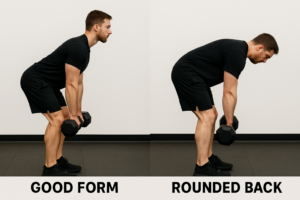
I was talking to a friend who said they hurt their back doing Romanian deadlifts (RDLs). Their conclusion: “My form must be wrong.” That’s a common takeaway in fitness—if you feel pain, your form must be bad. While technique matters, there’s something even more important when it comes to reducing pain and injury: gradual progression.
The big idea: your body adapts to the stress you give it—slowly. When you start strength training, pick a conservative starting point (sets, reps, and weight) that you feel confident completing with control. Then, over time, increase one variable at a time—weights, reps, or sets—at a steady, sustainable pace. If progressive overload is done properly, your tissues build tolerance and resilience. In other words, even if your form isn’t perfect, your body can still adapt and feel better over time.
A quick RDL example: we teach RDLs with a flat back—minimal spine motion, small knee bend, big hip hinge—because it targets the right muscles and is generally a safer position. But there are also deadlift variations where the back rounds more. Some lifters avoid these entirely; others gradually train them and report strong, pain-free backs because they built tolerance using positions many would label “unsafe.” The difference is not magic—it’s progressive exposure.
Think of walking on hot stones. No one starts by walking across a blazing path on day one. They build up tolerance gradually until something that seems unsafe becomes manageable for them. Strength training is similar: with the right progression, even “non-ideal” positions can become well tolerated.
What this means for you:
- Aim for optimal positions first. Good technique helps you train the target muscles and generally lowers risk.
- Start where you’re confident. Choose loads and volumes you can complete cleanly today.
- Progress slowly and steadily. Add a little weight, a few reps, or an extra set over time—not all at once.
- Respect your tolerance. Even perfect form can hurt if you exceed what your body is ready for—and even imperfect form can feel fine if you build up gradually.
Bottom line: technique matters—but tolerance matters more. Build it patiently and your body will get stronger, more resilient, and less prone to pain.
– James Pratt